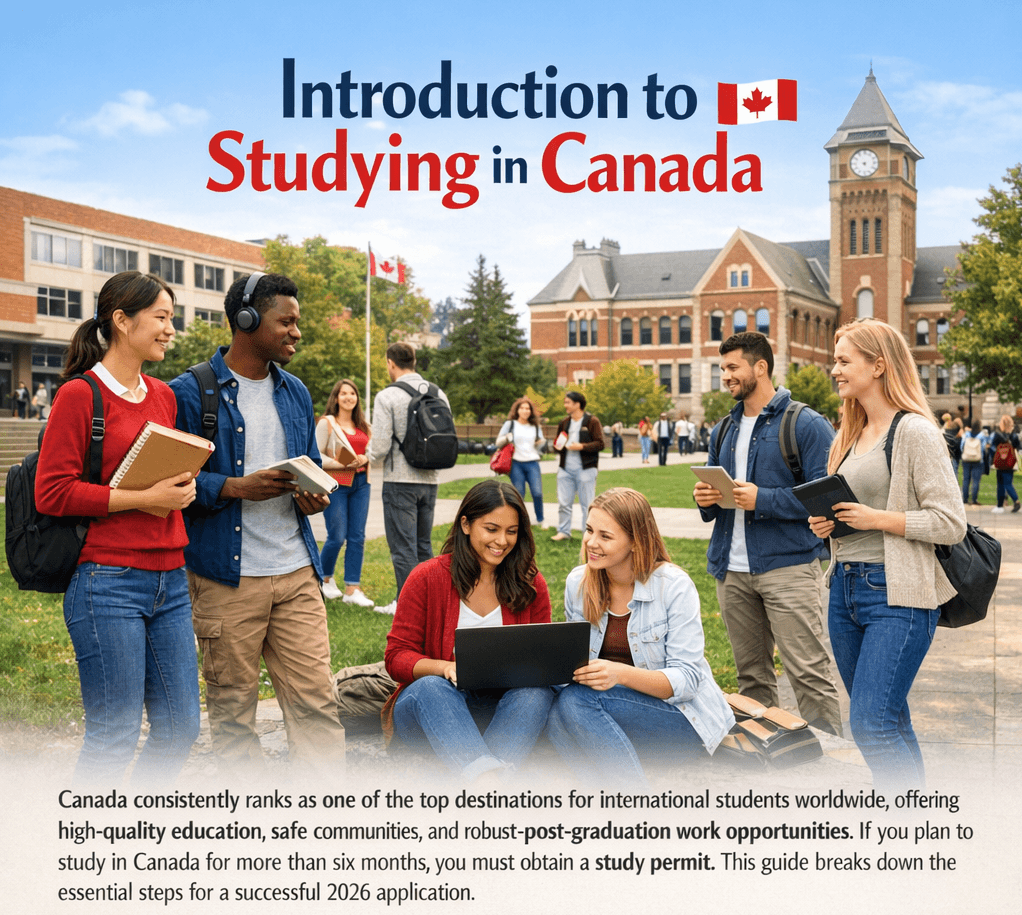
Introduction to Studying in Canada
Canada consistently ranks as one of the top destinations for international students worldwide, offering high-quality education, safe communities, and robust post-graduation work opportunities. If you plan to study in Canada for more than six months, you must obtain a study permit. This guide breaks down the essential steps for a successful 2026 application.
Step 1: Choosing a Designated Learning Institution (DLI)
To qualify for a study permit, you must be accepted by a designated learning institution (DLI). These are schools approved by a provincial or territorial government to host international students. If you aim to work in Canada after your studies, it is crucial to verify that your chosen program and DLI make you eligible for a Post-Graduation Work Permit (PGWP).
Step 2: Securing Your Letter of Acceptance (LOA)
Once you apply and are accepted into a DLI, you will receive a Letter of Acceptance (LOA). This document is mandatory for your study permit application. In 2026, depending on your province of study, you may also require a Provincial Attestation Letter (PAL) before you can submit your study permit application to IRCC.
Required Documents
- Letter of Acceptance (LOA) from your DLI
- Provincial Attestation Letter (PAL) (if applicable)
- Valid Passport
- Proof of Financial Support
- Letter of Explanation (detailing your study plan and ties to home country)
- Immigration Medical Exam (IME)
- Biometrics provided at a Visa Application Centre (VAC)
Demonstrating Proof of Funds
IRCC requires you to prove you can support yourself financially during your studies. You must show sufficient funds to cover your first-year tuition fees plus living expenses. For 2026, the baseline living expense requirement for a single student has increased to reflect the true cost of living in Canada. Strong evidence includes bank statements, Guaranteed Investment Certificates (GIC), and scholarship letters.
Processing Timeline
Study permit processing times fluctuate based on application volume and your country of residence. Generally, applications take between 4 to 12 weeks. Applying through the Student Direct Stream (SDS) – applicable to residents of certain countries – can expedite this process to under 20 days if you meet stricter upfront requirements like submitting a GIC and upfront language scores.
The Post-Graduation Work Permit (PGWP)
The PGWP allows international graduates to work in Canada, gaining valuable Canadian work experience that can later support a Permanent Residency application. Graduation from a PGWP-eligible program is non-negotiable. Always consult the official IRCC DLI list to confirm PGWP eligibility before paying tuition deposits.
Conclusion
Studying in Canada is a significant investment in your future. By carefully selecting a PGWP-eligible DLI, preparing a robust proof of funds package, and drafting a compelling letter of explanation, you can navigate the study permit process with confidence.