
A study permit refused on financial grounds does not always mean you didn't have enough money. Very often, the problem was how you proved where that money came from.
If you're applying for a Canadian study permit in 2026, there are some important things you need to know about proof of funds (POF), including one major number that changed on September 1, 2026. This guide covers the do's and the don'ts: what you are actually required to show, and the mistakes that most often undermine an otherwise strong application.
First, the number that changed on September 1, 2026
Living-expense requirement, applications received on or after September 1, 2026: $23,448 CAD. For a single student studying anywhere in Canada outside Quebec, for one year of living expenses. Up from $22,895 for applications received before September 1, 2026.
The date your application is received determines which amounts apply. Applications submitted before September 1, 2026 are assessed using the cost-of-living amounts that were in force when they were received, so a refusal from earlier in the year was measured against the older figure. These amounts are updated every year, which is why you should always check the current IRCC proof of financial support page before you submit.
The federal amounts are set annually at 75% of Statistics Canada's Low Income Cut-Off for the applicable family size, and they cover living expenses only, no tuition, no travel.
The DO's of proof of funds
DO #1: Know the new financial requirement. If you are a single student studying outside Quebec and your application is received on or after September 1, 2026, you must show $23,448 CAD for one year of living expenses. That is $553 more than the previous requirement of $22,895. The amount increases with the number of family members accompanying you, see the full table below.
DO #2: Don't mistake the living-expense amount for the total you need. This is where a lot of applicants, and a lot of refusals, come from. The $23,448 figure is a living-expenses number. It is not your total proof of funds.
IRCC requires you to prove you have enough money, without working in Canada, to cover all of the following:
- Tuition fees for your course or program
- Living expenses for yourself and the family members who come with you to Canada
- Transportation to and from Canada for yourself and your accompanying family members
And if your program is longer than one year, you must also explain how you intend to fund the remaining years, for example, through a multi-year scholarship, or by documenting your parents' ongoing employment and income.
So don't look at $23,448, check your balance, and say "perfect, I have that." Build the whole financial picture first: tuition plus living plus travel plus a credible plan for years two, three and four.
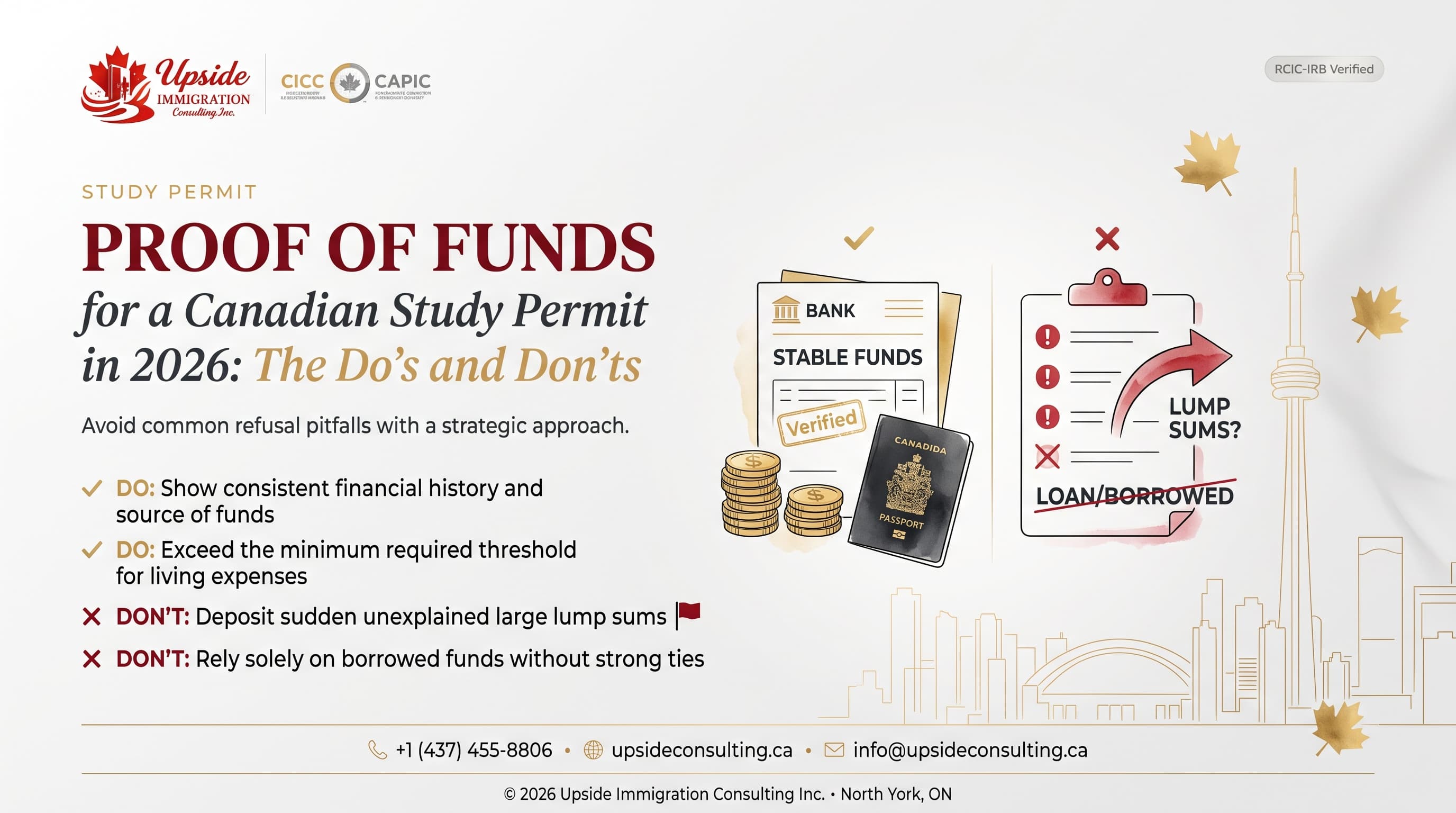
DO #3: Show where the money came from. This is where many applications get into trouble, and it is the single most misunderstood part of proof of funds.
You are not only assessed on how much money you have, you are assessed on the source of those funds. Since the July 2026 updates to IRCC's officer instructions, officers are directed to assess the source of an applicant's funds in all cases, not only where risk indicators are present. This is a change of emphasis: a strong closing balance is no longer a strong application on its own.
Your bank statement should not simply show a large balance. It should be accompanied by documents that help the officer understand how you accumulated that money, and whether it is genuinely available to you.
What IRCC's guidance points to:
- Bank statements covering the past six months, Canadian or foreign, including the month you submitted your application or the month immediately before it.
- Those statements must be supported by documentation showing the source of the income: employment income, savings transfers, and so on.
- Where a third party is funding you, a letter from the person or institution giving you the money, stating their occupation or employment, their relationship to you, the number of their dependants, and the amount of support.
- Proof of your relationship to that person, plus a copy of their identification photo or proof of their business registration.
- Other acceptable evidence includes a Guaranteed Investment Certificate (GIC) from a Canadian financial institution, proof of a student or education loan from a bank, pay stubs from recent employment, pension documents, rental income, or proof of a Canadian bank account in your name if you have already transferred money to Canada.
If you receive a large deposit in your account, don't leave the officer guessing. Explain it. Document it. Make it traceable. A six-month statement that shows a steady, explainable build-up of funds tells a far better story than a single impressive-looking balance.
Living expenses are one line item in your proof of funds, not the whole document. IRCC assesses the amount and the source, and confirms that the funds are available to you for the full duration of your studies.
The DON'Ts of proof of funds
DON'T #1: Suddenly deposit a huge amount of money right before you apply. If your account normally holds a modest balance and then receives a massive deposit just before you apply, with no explanation, you should expect questions. You need to be prepared to explain where that money came from and why it is legitimately available for your studies.
Remember: simply having money in an account does not automatically answer the financial-capacity question. The question is also: where did it come from? If a relative transferred the funds, document the relationship, the source of their money, and their capacity to support you, the same way you would document any other funding source. Seasoned funds with a paper trail are always stronger than recently arrived funds with none.
DON'T #2: Assume that paying your tuition means you're financially covered. Paying your first year of tuition can certainly be part of your financial evidence, IRCC explicitly accepts proof of paid tuition and housing fees. But it must be accompanied by other documents proving you have sufficient funds for living expenses and transportation costs.
A receipt from your designated learning institution is evidence of one line item. It is not evidence of financial capacity on its own. Think of your proof of funds as a complete financial story, not a single bank balance or a single receipt.
DON'T #3: Use the regular figures if you're studying in Quebec. Quebec sets its own financial requirements, and they are higher. If you plan to study in Quebec, you must also apply for the Quebec Acceptance Certificate (CAQ), where applicable, in addition to your study permit, and the same funds are assessed by both the provincial and federal governments. You do not need to show two separate piles of money; you do need to meet Quebec's numbers.
Quebec proof-of-funds requirements for one year of study, as updated January 1, 2026. These figures exclude tuition and transportation costs.
| Number of Family Members | Funds Required for One Year |
|---|---|
| 1 (principal applicant) | $24,617 |
| 2 | $34,814 |
| 3 | $42,638 |
| 4 | $49,234 |
| 5 | $55,045 |
| 6 | $60,299 |
| Each additional family member | $5,254 |
So don't take the $23,448 figure and automatically apply it to every study permit application. Where you study changes the amount you must show.
DON'T #4: Ignore foreign-exchange restrictions. If your country has foreign exchange controls, having money on paper is not enough. You must demonstrate that you will actually be permitted to export the funds needed for all of your expenses, tuition, living costs and travel.
This is a requirement that IRCC states explicitly, and it is more important than many applicants realise: funds you cannot legally move are not funds the officer can count.
The amounts, in full: applications received on or after September 1, 2026
Cost-of-living (living-expense) amounts for study permit applications received on or after September 1, 2026, studying outside Quebec. These amounts do not include tuition or transportation.
| Number of Family Members | Amount Required | Change from Previous |
|---|---|---|
| 1 (principal applicant) | $23,448 | +$553 |
| 2 | $29,192 | +$690 |
| 3 | $35,888 | +$848 |
| 4 | $43,572 | +$1,029 |
| 5 | $49,419 | +$1,167 |
| 6 | $55,736 | +$1,316 |
| 7 | $62,054 | +$1,465 |
| Each additional family member | $6,318 | +$148 |
When IRCC calculates your family size for these amounts, it counts you plus any family members accompanying you to Canada. Transportation costs are calculated the same way.
The big takeaway
Proof of funds is not just about how much money you have. It is about whether you can demonstrate that the money is:
- Available, genuinely yours or genuinely committed to you, and accessible
- Legitimate, from an explainable, lawful source
- Traceable, documented on paper, with a clear paper trail
- Sufficient, covering the full financial requirements of your studies, not one line item
And remember, these financial amounts are updated annually. Always check the current IRCC requirements before you submit your application, and check your country's visa office instructions, which can add local requirements on top of the federal ones.
Already refused, especially on financial capacity grounds?
If you have already received a refusal, and the officer raised concerns about financial capacity, the useful next step is a careful review, not a re-application with the same documents and a bigger balance.
A refusal review looks at what the officer actually wrote, what concerns were raised, and whether your supporting documents answered those concerns. Often the money was never the issue: the gap was in how the funds were explained, documented and connected to your study plan. That is a fixable problem, but only if you understand what specifically triggered the refusal before you re-submit.
Preparing a study permit application, or dealing with a refusal?
If you are preparing a study permit application, book a consultation with Scholar Acha, RCIC-IRB. I can assist with reviewing your financial documents and the overall strength of your application before you submit it.
And if you have already received a refusal, especially where the officer has raised concerns about financial capacity, I can also review the refusal and your supporting documents to help identify the concerns and determine how they can be properly addressed.
This article is general information about Canadian study permit requirements and is not legal or immigration advice for your specific situation. Financial requirements are reviewed and updated annually, and individual visa offices may impose additional requirements. Always confirm the current requirements on the official IRCC website before submitting an application, and consult a qualified professional about your own case.